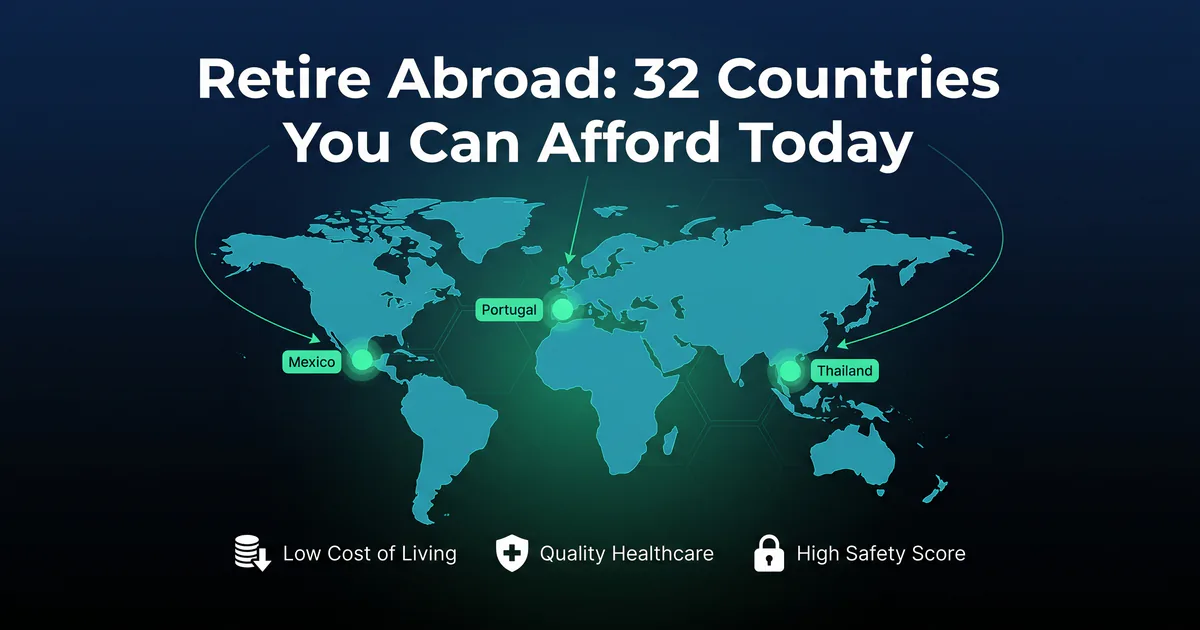
Google “retire abroad calculator” and the number one result is not a calculator. It is a three-question quiz from International Living that recommends their magazine. The second result is a generic cost-of-living widget with no FIRE logic. The third is a raw data dump of 9,294 cities with no filtering.
Nobody has built the actual tool. And yet it is the most important calculator a future expat retiree could possibly use — one that takes your savings, your monthly income needs, and your lifestyle preferences, then shows you every country where you can retire right now.
This guide does the job the missing calculator should do. We walk through the math, the country-by-country cost data, visa pathways, and the decision framework to pick the right destination. By the end you will know whether you can retire abroad today — and if not today, exactly how far off you are.
Why Retiring Abroad Is Mathematically Different From Retiring at Home
A standard retirement calculator computes one number: how much you need. $1 million. $2 million. $5 million depending on assumptions. The problem is that this number assumes a fixed cost of living.
Retiring abroad breaks that assumption. If Portugal costs half of San Francisco, your “retirement number” in Portugal is half. That is not an adjustment; it is a transformation of the entire plan. What took 25 years of saving at home might take 12 abroad.
The same couple, the same portfolio, fundamentally different life outcomes based on where they retire.
The best summary of this insight comes from a retiree quoted on CNBC describing his Portugal retirement: “We save about $5,000 per month.” He is retired. He is saving. Because his location changed the math.
The Retire Abroad Calculator, Explained
A proper retire abroad calculator needs six inputs:
- Total invested assets (portfolio + retirement accounts, not primary home equity)
- Additional income (pensions, social security, rental income)
- Desired monthly spending (in today’s purchasing power, not a specific currency)
- Risk tolerance (how close to the edge of your FI number you are willing to retire)
- Lifestyle preferences (climate, language, healthcare quality, safety requirements)
- Time horizon (how long you need the money to last)
The calculator then:
- Converts your spend into local-currency equivalents for 30+ candidate countries
- Calculates the sustainable withdrawal rate at each country’s cost base (typically 3.5-4 percent for 30+ year horizons)
- Filters by visa eligibility given your citizenship and income profile
- Ranks countries by “years until retirement” starting from today
For most mid-career US and European savers with $400,000-$800,000 saved, the list of countries where “years until retirement = 0” is surprisingly long.
As the author behind thegoodlifejourney.com observed after running the math: “We could already retire in 32 different countries in the dataset, including Malaysia, Philippines, Colombia, Vietnam, or Indonesia.”
Monthly Cost Per Country for a Comfortable Retired Couple
The number you want is not “cost of living index.” You want “what does it actually cost two people to live a middle-class retirement in this country?” Here is the 2026 data:
| Country | Monthly cost (couple, comfortable) | FIRE portfolio needed (4% rule) | Primary retirement visa |
|---|---|---|---|
| Thailand | $2,000-$2,800 | $600k-$840k | Long-Term Resident (LTR), 10 yrs |
| Vietnam | $1,600-$2,200 | $480k-$660k | Investor or Family visa |
| Philippines | $2,000-$2,600 | $600k-$780k | SRRV (Special Resident Retiree Visa) |
| Malaysia | $2,200-$3,000 | $660k-$900k | MM2H (My Second Home), 5-20 yrs |
| Mexico | $2,400-$3,400 | $720k-$1.02M | Temporary/Permanent Resident |
| Panama | $2,600-$3,400 | $780k-$1.02M | Pensionado ($1k/mo income) |
| Ecuador | $1,800-$2,400 | $540k-$720k | Pensioner Visa ($800/mo income) |
| Colombia | $2,000-$2,800 | $600k-$840k | Retirement (Type M) Visa |
| Costa Rica | $2,800-$3,800 | $840k-$1.14M | Pensionado ($1k/mo income) |
| Portugal | $3,000-$4,000 | $900k-$1.2M | D7 or Digital Nomad Visa |
| Spain | $3,200-$4,200 | $960k-$1.26M | Non-Lucrative Visa |
| Georgia | $1,500-$2,200 | $450k-$660k | 1-yr visa-free (most passports) |
Compare that to US benchmarks: Austin costs $4,800-$5,800/month for a comfortable retired couple, San Francisco $6,500-$7,800, Denver $4,200-$5,200. The gap ranges from 30 percent (Spain) to 75 percent (Vietnam).
The CNBC-quoted Alex Trias who retired at 41 in Portugal is not an outlier. He is one of thousands who ran the numbers and realized, in the words of one community member quoted on Rewire Abroad: “The math was undeniable — I was already there.”
Visa Options by Country (Who Can Actually Use Them)
Visa pathways are the hidden filter. You can have the money and still be unable to stay legally. Here is what actually works in 2026:
Retirement visas with income thresholds (easiest)
- Panama Pensionado — $1,000/month passive income from pension or social security. Lifetime validity. Discounts on flights, healthcare, utilities.
- Ecuador Pensioner — $800/month passive income. Permanent residency after two years.
- Costa Rica Pensionado — $1,000/month guaranteed pension. Temporary residency renewable every two years.
- Mexico Temporary Resident — approximately $4,500/month income OR $75,000 in savings (threshold updates annually). Four-year renewable.
- Spain Non-Lucrative Visa — approximately $34,000/year passive income for a single, higher for families. Annual renewal.
Investment-based residency (higher threshold, more flexibility)
- Portugal D7 — proof of passive income equal to or exceeding the Portuguese minimum wage, usually $1,100-$1,500/month per person.
- Malaysia MM2H — revised 2024: roughly $120,000 liquid assets and $25,000/month income (Silver tier) to $250,000 liquid and $50,000/month (Gold tier).
- Thailand LTR — proof of $80,000/year income OR $1M assets plus $40,000/year income.
Digital nomad and remote work visas
- Portugal Digital Nomad Visa — remote income of ~$3,500/month. Valid 1-2 years, renewable.
- Spain Digital Nomad Visa — remote income of ~$2,800/month. Up to 5 years.
- Mexico Temporary Resident (via remote work) — same thresholds as above but many approve on remote employer letters.
- Colombia Digital Nomad Visa — introduced 2023, valid 2 years.
Pick a country where you meet the visa income requirement with room to spare. The 2025 policy change — Thailand and Argentina declared they won’t allow visa runs anymore — reminded the community that tourist-visa-based lives are no longer a reliable long-term plan.
Decision Framework: Picking Your Country
With 20+ realistic options, decision paralysis is the main risk. Use this filter in order:
Filter 1: Visa feasibility. Remove countries where you do not meet the visa income/asset thresholds. This typically cuts the list in half.
Filter 2: Healthcare. Rule out countries where the healthcare you can access will not meet your needs. Thailand and Portugal have excellent private systems. Vietnam and the Philippines are more variable.
Filter 3: Climate. Be honest about heat, humidity, and seasonality. A contributor on tawcan.com put it bluntly: “Cost of living is not everything. Weather can be a deal breaker, and a person has to research carefully.”
Filter 4: Language and culture. One year in Tbilisi sounds romantic; five years without reliable English around you is isolating. Visit first.
Filter 5: Proximity to family. This is the most overlooked cost. Flights home at Thanksgiving, Christmas, and for emergencies add up. Mexico and Panama stay on the shortlist for US retirees partly because of a four-hour flight home.
Filter 6: Tax treaty. Check whether your home country has a tax treaty with the destination. It usually matters less than expected for retirees (pension income is typically taxed only at home) but matters a lot for retirees with rental income or capital gains.
What is left is usually two or three countries. Visit each for at least a month before committing.
The Arithmetic for a Real Couple
Meet Sarah and James, both 58, combined portfolio $680,000, plus Sarah’s pension of $2,100/month. They want to spend $3,200/month in retirement.
Their US options: marginal. At $3,200/month spend ($38,400/year), their FIRE target is $960,000. With the pension covering $25,200/year of that, they need a portfolio generating $13,200/year, or $330,000. Already cleared that bar. But a $3,200/month lifestyle in most of the US means a small apartment in a secondary city.
Now run the same numbers for Portugal (Porto). Same $3,200/month buys a two-bedroom apartment in a nice neighborhood, private healthcare, weekly dining out, monthly travel. In Thailand (Chiang Mai), it is a comfortable, almost luxurious lifestyle.
They are retired now — in the US at “lean” standards or abroad at “comfortable.” Most couples in this situation pick abroad.
What a Good Calculator Does That a Quiz Does Not
The International Living quiz — the top Google result — asks three questions (budget, weather, language) and routes you to their magazine. That is not a calculator. It is a lead capture form.
A real retire abroad calculator should:
- Accept your actual financial position, not a budget bucket
- Account for your specific citizenship (affects visa options)
- Show multiple countries that match, ranked by years-until-retirement
- Include visa thresholds, healthcare scores, climate indicators
- Update with real data, not 2018 Numbeo crowdsourced estimates
IndepAI is building exactly this tool. It takes your financials, cross-references against 11,400+ livable cities in our dataset, and returns the ranked country list with monthly breakdowns and visa pathways. See our what is geo-arbitrage guide for the underlying framework.
Get the Calculator First
If you are actively planning a move in the next 12–24 months, open the live Geo-Arbitrage Calculator. Enter two cities, then create a free account to reveal the complete result.
Related Reading
- Geo-Arbitrage Calculator Guide — the sibling tool for active earners
- Lean FIRE by Country — real numbers for 10 low-cost countries
- FIRE Calculator Europe — for European citizens staying in the EU
- Best Countries for FIRE 2026 — country-level rankings
- Barista FIRE International — for semi-retirees with part-time income
- What is Coast FIRE? — for those a few years short of full retirement
Free account required
Your result is ready. Create an account to reveal it.
Register free to see the complete result, save scenarios, and keep every calculator in one FI plan.
Free account. No credit card.